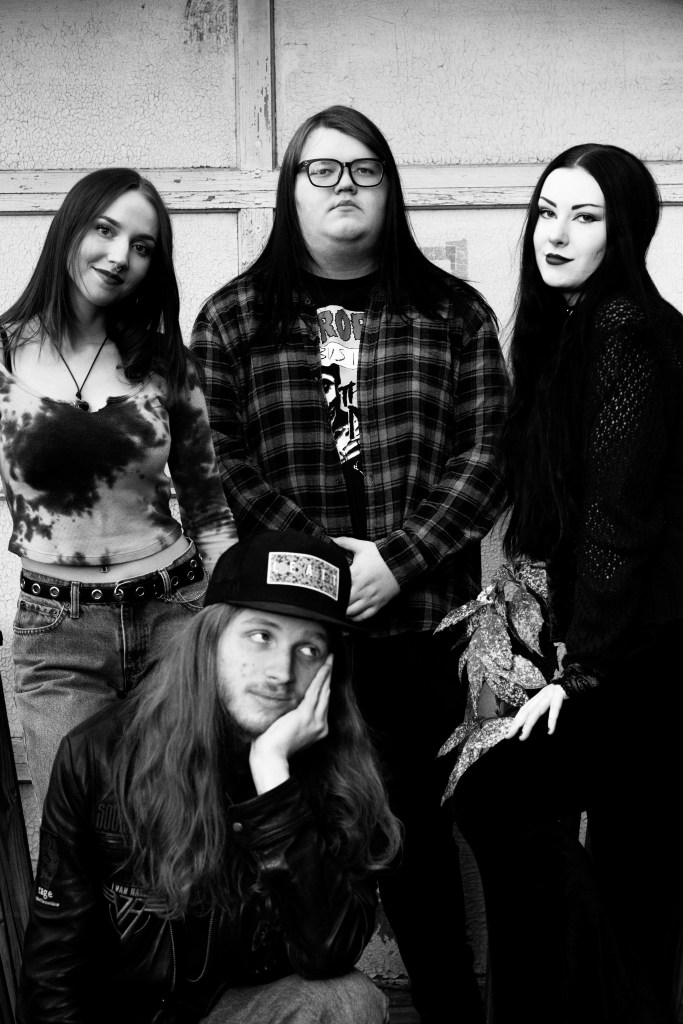
(True Lilith from left to right: Anna Spurrier, Jared Stone and Clay Case, Chloe James)
Interview by A.G.M. (Life on the Charlotte Scene)
Photos by Seth Rodriguez (@innerdistortion)
“Lilith was a demon from Hebrew folklore that killed babies in the middle of the night.” This is the soundbite that opens up True Lilith’s newest single, “Slave to the Siren”, before detonating into a sinister and tantalizing electro-bass riff, followed by encircling goth synth waves and Chloe James’s melodically haunting vocals: “There’s blood on your white dress, you felt like a misfit.”
The line heard at the song’s introduction is actually a snippet from a hearing in Monroe County Court last Summer, where an anti-LGBT protester attempted to convince Union County to cancel their yearly Pride event in 2023. True Lilith, one of the bands set to perform at the event, was mentioned by the protestor in an attempt to associate the band with satanism and witchcraft, seeking to use the band as ammunition for her claim that Monroe’s Pride event should be banned as it was “unfit for children.” Nevertheless, Union County Pride went on as planned: True Lilith performed as arranged, and the in-court soundbite now lives on as an iconic spoken word intro and playful “Fuck you” for the band’s single.
The use of seductive, dark femininity as a means for one’s self-preservation and autonomy is a present theme not only within the tongue-in-cheek sacrificial imagery of Slave to the Siren, but throughout much of True Lilith’s music. Bodiless ghosts and vengeful siren-like goddesses are all featured lyrical characters within the band’s discography, serving as an allegory for femme disempowerment, rage, and the recapturing of one’s volition. Urban Decay, a coiling and dynamic dark-synth pop track features lyrics written by Chloe James in light of North Carolina’s legislative ban on abortions after 12 weeks back in May under Senate Bill 20, NC following in a larger trend of State’s enacting legislation overturning the decades-long precedent of bodily autonomy established by Roe v. Wade in 1973. Amidst a mounting tension of eerie synth, thundering guitar, and sinister bass, Chloe bellows passionately: “I hate that my fate is obliterated… Where is your empathy? Decayed reality, our rights are melting…”
Synthy, seductive, and psychedelic, True Lilith has been sweeping Charlotte with their goth-rock sound since 2017, with both Slave to the Siren and Urban Decay marking the band’s most recent releases back in 2023. I first spoke to front woman and guitarist Chloe James, bassist Clay Case, keyboardist Anna Spurrier, and drummer Jared Stone almost a year ago, last March. Down to earth, kind, and talented, True Lilith was the first band I ever interviewed, and the band that first introduced me to Charlotte’s local D.I.Y. scene, full of passionate young musicians who, like Lilith, seek to bring a unique sound to share with their local scene. In the interview below, True Lilith discussed their beginnings, the importance of local music, and the band’s first two albums, Wilt (2019), and Celestopia (2022).
Origins
“True Lilith started in 2017, when I really wanted to just try and start a band. I tried to write a couple of rifts and turn them into songs. In late 2018, we had our first little small show. Since then, the line-up has changed a lot,” says front woman Chloe James.
True Lilith in its current capacity would come to be formed after many band members came and went, with founder James being the only remaining original member. Jared Stone, Lilith’s drummer, would join the band in August of 2022, after previously meeting James a few years earlier in 2019.
“I joined last August, but I’d been listening to True Lilith before I even joined the band. It’s actually a funny story- I created an AI bot account for Tinder because I was bored, and I met Chloe through Tinder. I asked her ‘How may I help you?’ and she responded with something like ‘Fix my life,’” Jared recounts as the two share a laugh across the table. “I got the link to her band’s page from her profile, and that’s how I found True Lilith. I saw them at the tail end of 2019, I think it was at the Skylark or Milestone. Then, I saw on their Instagram one day that they were looking for a drummer. So, I text them, and a week later, I’m in practice. I’m in the band,” Jared recalls, grinning.
A little while later, Anna Spurrier, Lilith’s keyboardist, would join Chloe and Jared in the band. “We were a three-piece, but we knew we wanted a synthesizer,” says James.
“I joined in September 2022. Chloe and I went to high school together, I was a freshman when she was a senior. I’ve played piano since I was five–it’s very different [playing in a band]. I grew up playing solos, but now that I’m in a band, I have to play a part for a song, not the entire song. My dad’s been a musician my entire life, his full-time job is playing in a band. I never thought it would be me,” says Anna.
When Lilith’s old bass player would leave the band shortly after Anna’s arrival, Jared would reach out to an old bandmate, Clay Case, to fill the spot. The two had met earlier in high school, playing together in a school percussion band for about a year before going on to pursue other musical projects together before eventually joining True Lilith.
“Jared gave me a call, he said: ‘I got an opportunity for you, I need a bass player”, Clay recalls. “I played my first show with the band on November 26th, 2022. It’s been my dream to play in a band like this…I just, as the kids say, ‘fucking sent it’. It felt right,” says Clay.
“It’s kind of a death of that first iteration of True Lilith, there was a sort of rebirth with all of us. Everyone is so unified: Giving our own opinions, we can all talk about music and ideas together, and it’s never a competition,” says Anna.
In speaking with True Lilith, it’s apparent just how much appreciation the members of the band have for one another, as well as their centered emphasis on a collaborative approach to songwriting. “It’s a shared experience,” says Chloe, “ It’s like a bus with four tires, each tire has to keep going for it to work. A band is a group effort, everyone has to be doing their part.”
“I think it’s cool, we’re all starting to become our own person and grow at the same time. Any time we write our stuff, we all contribute our styles together to create something really cool,” says keyboardist Anna.
“It’s a family. I don’t look at this band as just a group of friends, I look at it as a family. I care about these three people as much as I care about my dad and my sister. It’s a sense of that mesh, we’re connecting in a way that a lot of people aren’t going to–with music, playing it and hearing it are two completely different things,” adds Case.
“We always have a pep talk before a show, Clay usually starts it,” Chloe says, “Normally we just say: ‘play for each other.’ Either people get it, or they don’t.”
“That really helped me get over my stage fright,” adds Chloe. “If I’m kind of nervous, I know they’ve got me.”
Musical Awakenings and Early Inspirations
“Guitar was first introduced to me when I was seven,” says James. “I wanted a Wii really bad for Christmas in 2007, y’know, to play those girly Barbie video games they had back then. And Santa did buy me a Wii, but it came with Guitar Hero instead of Barbie,” she smiles. “First I hated it, but then I fell in love with it. My dad’s really into Alice in Chains, Nirvana– he likes a lot of that kind of music. One of my biggest musical influences is definitely The Cure. We all love The Cure. When I was 14, I got really into bands like Sisters of Mercy, Bauhaus, Joy Division, and The Cure. Their music is all very heavily ingrained in me. That was the first kind of scene I really identified with,” says James.
“Chloe and I both got that Wii in 2007 that had Guitar Hero 3”, adds Jared. “The Guitar Hero: Metallica– that was the one,” he laughs.
“My dad listened to everything: country, metal, punk, bluegrass, anything. He was an all-encompassing kind of listener. From there, I knew I wanted to learn an instrument, but I just didn’t know where to start”, says Jared. “I started playing in a middle school band when I was 12, and that was when I first learned the drums. Two years later, I got a guitar and a video game called Rocksmith, which was like Guitar Hero, except you play along on a real guitar. I tried to learn every song I could, that’s where the love comes from. I try to listen to whatever I can, whether it be grunge, country, or pop punk, I’m like my father in that sense. I think the one thing I don’t like is boring music. You can definitely tell the difference between a song that is actually doing something interesting on a track, and one that isn’t–whether that be pop or experimental… I try to take all of that influence,” says Stone.
“My dad’s a jazz musician–he definitely influenced my style, [his music was] very jazzy, very soulful, that’s what I grew up listening to the most ”, explains Anna. “I remember being really little, and always being in a studio somewhere with him, or going to his gigs. I grew up listening to a lot of Stevie Wonder, Miles Davis, Bootsy Collins, James Brown, and Ella Fitzgerald. I grew up on a lot of rock and metal stuff too, like Metallica. There was an ACDC CD my dad would always bring in his car, the one that has TNT on it.”
She adds: “I play bass a bit too– I remember when I was nine years old, my dad took me to see this band called Esperanza’s Spalding. There was this bassist who was a girl, and after that, I remember thinking, ‘ I want to play bass and be exactly like her.’ A lot of the people my dad played music with, I saw them as like my godparents,” recalls Spurrier.
In similar fashion to the rest of the band, Case’s father also played an important role in the bassist’s introduction to music: “My dad taught me guitar, which he had learned, y’know, to give him something to do, ‘cause he had lived in the middle of Texas. We learned a lot of Korn and Seether. When I was born, that record, Karma and Effect, had just come out, so I was cranking “Remedy” at like, four. He taught me how to play “Smells Like Teen Spirit”, I figured it out, and then I started learning anything I could get my hands on: Green Day, Nirvana, Metallica. Fast forward after playing guitar consistently, the first thing I tried to learn on bass was “Pulling Teeth” by Green Day. I was super into pop-punk, so Blink-182 and Mark Hoppus were a big influence on me. I tend to see my bass as my guitar,” says Case.
True Lilith
“I was looking for a cool name that wasn’t taken–at the time, I remember I was researching astrology terms, and there was this term, True Lilith, which is your subconscious psychology: the dark aspects of yourself that even you don’t want to acknowledge. Lilith was Adam’s [darker aspects] before Eve. It kind of embodies dark, feminine power,” says James.
Wilt and Celestopia
“The first album, Wilt, was the bare bones for me: I wrote it when I was 16. It was my first time writing songs”, says James. Wilt, released in 2019, consists of four songs: “Wilt”, “Melancholia”, “Velveteen Daydream”, and “Slow Burn”. James’ songwriting and musicality within her first project features the synthy, goth-grunge sound that is characteristic of True Lilith, the project standing as an impressive feat to have undertaken alone as a young musician. Front woman James says of her inspiration for writing the album: “I was really depressed at the time, just trying to live up to people’s expectations, and not being able to at the time. Feeling flat for it. There’s this judgment people receive when they’re dealing with depression and other mental health issues, and a lack of empathy. You should just embrace it when you’re dealing with it, not feel like you have to hide it and fit into society.”
True Lilith’s second album, Celestopia, was released in 2022. Featuring a good mix of live favorites such as “The Tower”, “Dim The Lights”, “Calypso”, and “Trash”, the album includes both punky, rhythm-driven songs and gothic, synth-swirling ghost stories. “Graveyard of Stars” vocalizes the vengeance of a dead girl envious of the living: Amidst coiling riffs and two-stepping cymbal clashes, James hauntingly lulls the lines “You attach yourself to me, you attach your soul to me” like a venomous curse.
“That song is actually about a dead ghost girl, trying to steal the body of a living girl”, says James. “If you look at the lyrics, you can sort of tell. It’s about someone who’s passed, who is sort of stuck in-between, and they haven’t moved on to whatever comes after. They’re desperately just wanting to crawl into someone’s body and relive all that they missed out on,” explains James.
Live Performance and The Local Scene
Speaking with True Lilith, it’s apparent that the local music scene provides a cherished community for the band, with live performances serving as an important catalyst for the group’s creative process. Lilith’s bassist, Clay Case, recounts his experience being pulled onstage during a Green Day concert to play for the crowd. Although it was undoubtedly a special experience, Case says that live performances at local, smaller venues are intimate, special, and irreplaceable in a way that larger shows often fail to measure up to.
“Green Day is my biggest inspiration for guitar- Mike Dirnt is a big name for bass, too. I was at a Green Day concert in Atlanta in 2021, and they were pulling people up on stage: I was the guy they pulled up. I played a solo, which I don’t even remember because the adrenaline hit, and Billy Joe was like ‘Do you know Basket Case?’, so I stayed on and played “Basket Case” with them, too,” recounts the bassist. “The thing is, though– the biggest thing I didn’t get from that, was a sense of community. Playing with True Lilith, it’s such a close-knit scene around here, and with Green Day, it was like: ‘Oh, there’s the first row’, and then just pitch black beyond that. There’s just not that same intimacy. Like, playing at The Milestone, that show [in January] where that dude in the mosh pushed off my bass– it was just crazy,” describes Clay. “Milestone, I think that’s my favorite venue, maybe because that’s the most bad-ass show I’ve ever played.”
“I think that’s mine too,” agrees front woman James. “It’s the heart of the punk scene in Charlotte–they’re very supportive of local bands, which is important because a lot of local bands are dying since many venues in Charlotte have a bad habit of booking mostly cover bands, often over local groups”, she adds. “As a band, it can be very tempting to replicate something that’s already been produced, or fit into this ‘cookie-cutter’ sound. But, as much as I’d like to sound like, say, The Cure–that’s already been done before. The art is in adding and making something new, and that’s why it’s important to support local bands. These bands are out here working hard and writing their own music, and many times, they get pushed under these cover bands, which are oftentimes just profiting off of nostalgia,” explains James.
In addition to creating original music as a group and fueling Charlotte’s local scene, performing as a female-fronted band is another focal point of importance for True Lilith.
“It means a lot to be a female-fronted band,” says Chloe. “When we first played The Milestone in 2019, the scene was dead, and after COVID, people realized they took it a bit for granted. We got to play a lot of festivals, like Fem Fest in Winston-Salem, which raises funds for domestic violence and sexual abuse victims. It definitely means a lot to me to be able to do something to help people, instead of just saying ‘We’re a female-fronted band’– we get to actually contribute.”
“I think it’s good that young women can see us play. They can see us, and feel inspired to play music, too,” adds Spurrier.
“I’ve experienced so much misogyny, being objectified by men in the scene. But I have to just say, ‘Fuck you, I’m gonna keep going,” says Chloe.
**********
Check out Slave to the Siren and Urban Decay on Spotify, along with the rest of True Lilith’s discography. You can catch True Lilith, along with Once Below Joy, Dad Bod, and Motel Glory, live on March 15th at The Courtroom in Rock Hill, SC.
 fuelthescene.com