
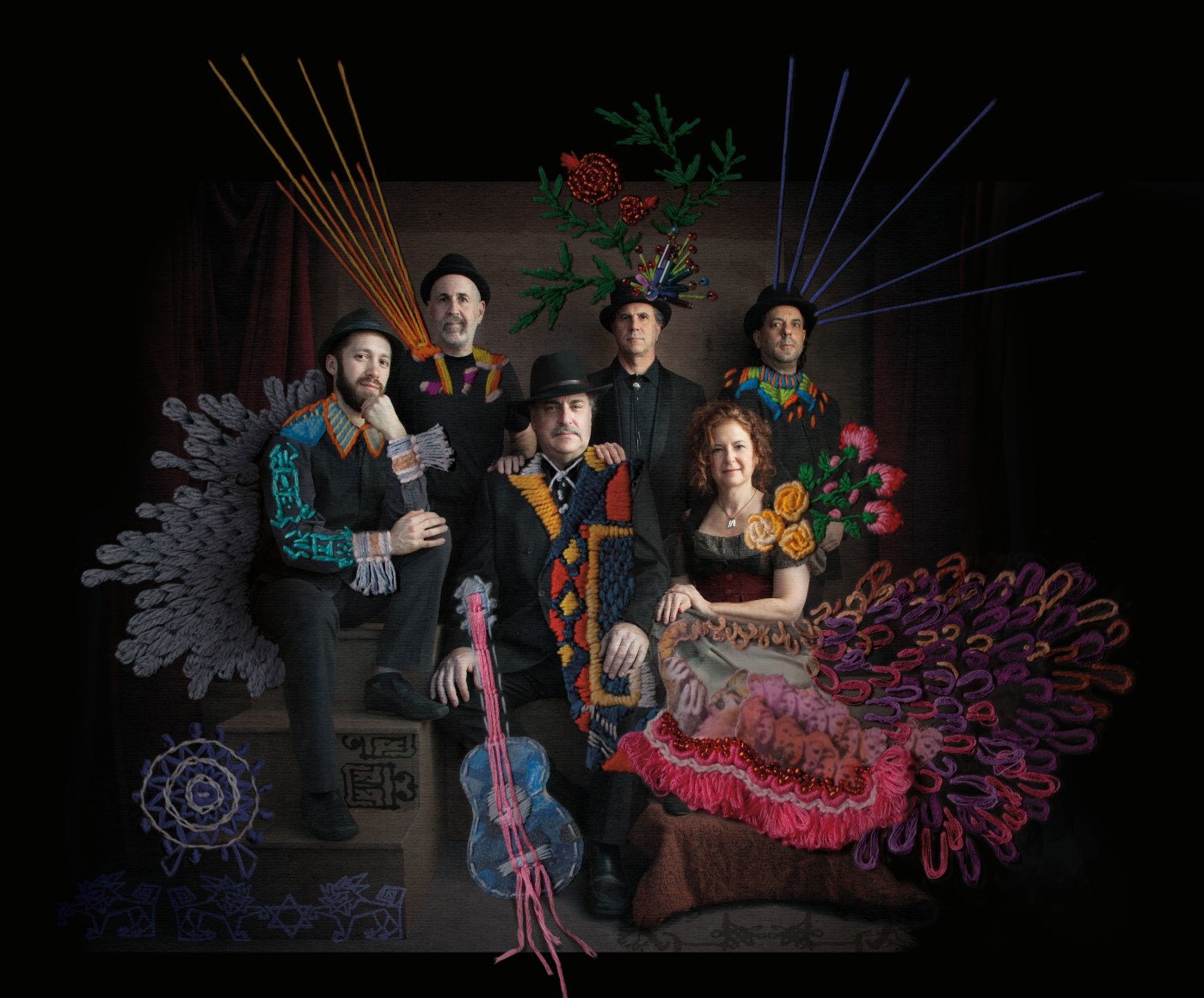
Photo by: Adrian Buckmaster Design – Ann Nikolaenko; Interview by Valkyrie Lofgren
The Klezmatics are celebrating 40 years with the release of their latest album, We Were Made for These Times. Building on labor anthems and protest songs, We Were Made for These Times combines Yiddish folk song with jazz, Black gospel, and Latin-American rhythms and continues the band’s tradition of pushing boundaries, both in music and attitude. The album breaks through barriers of language and culture to inspire resistance and leaves us with a message of hope.
At the heart of it all is vocalist and multi-instrumentalist, Lorin Sklamberg. I caught up with Sklamberg to talk about the album, supporting tour, and what it means to collaborate and resist in our current political atmosphere. Check out the interview below and stay tuned for photos and a review for their upcoming St. Louis, MO show at The Sheldon Concert Hall on May 20, 2026!
Valkyrie Lofgren: The Klezmatics have been described as a klezmer band with a twist. Who have been some of your musical influences over the years? Is there a particular genre or culture that’s really shaped your sound?
Lorin Sklamberg: I think you name it and it’s influenced us. Certainly the band’s history as musicians informs that. There are a couple people who have played a lot of Irish music. That overlaps with people who have played jazz. I have a background in classical music and in different world music and American folk music. A couple of other people have backgrounds in Balkan music and some music from the Middle East, so those different kinds of music inform what we’ve done over the years.
Lofgren: You can definitely hear the jazz and Irish influences. I love it! When the band started in ’86, you sparked a klezmer revival, but you’re fairly non-traditional. Have you had to deal with a lot of criticism from purists along the way?
Sklamberg: Technically, we’re what you could call the second wave of the revival. As far as getting push back about what we were doing, there was a little bit, certainly, with our approach to some songs. We tended to shy away from things that were particularly well known. Early on we decided that we would focus on song material that spoke and continued to speak to us. When we did do things that people were familiar with, we would sort of change them around. Sometimes that meant that someone might come across a song in a book that they had no idea was particularly well known, and they might have looked at the song and maybe wouldn’t see how it would be taken at face value, and therefore, this must be meant ironically. So we would do something like that. I’m thinking in particular of a song called Fisher Lead, which has kind of always been sung as this romantic slow song. We took it in the direction of making a dance tune out of it and exposing the irony.I don’t know if it was intended by the poet, Aliza Greenblatt, who wrote it, but we enlisted the help of Betty. We tapped them to sing backup on it. So it had this kind of [punk] attitude about it. The push back was that people would say, “How can you take this beautiful, sad tune and sing it in such a happy way?” It’s sort of part of the tradition that our music can be historically ironic or that you might have something that has a happy or upbeat tune, but the words can be serious. Or they can be opposite of the musical setting.
Lofgren: What was it like coming up in the ’80s in New York City during a time when punk and hardcore were really dominating that scene? What venues were you playing?
Sklamberg: We got our start and our home base probably was the Knitting Factory. That was a hub for punk-ish sort of New York edgy music, but that’s one place we played a lot in the early days. We played at the original location and we played there when it moved to Leonard Street. So we had an association with the Knitting Factory. That kind of punky energy infused a lot of what we did early on because what we did was a reaction against, a sort of preciousness, especially around songs, and we might make things louder, faster, and that sort of thing. It’s sort of the same thing we’re still doing now.
Lofgren: Your new album We Were Made for These Times just dropped. It’s been described as connecting the band’s activist roots with today’s global stories. How do you feel your music is connected with what’s going on culturally right now?
Sklamberg: We were gearing up to do something like this since the pandemic. We started fooling around with some songs that ended up being on the recording. Then a couple of years ago when we started making plans for this album, we started focusing on things that would have sort of a universality to them as far as the world situation. For instance, we have an instrumental that’s called “Elegy for the Innocents” which is a Jewish style tune, but it has kind of a jazz underpinning. It starts like a jazz tune- it has an opening section then there’s a section of improvisation and it really expresses, more than anything, anger and grief instrumentally. One of the other things that we decided about this 40th anniversary album, which is our 14th, is that we would try and work with people who are old friends of ours from the New York scene or new friends. We worked with with James Brandon Lewis, who’s a saxophonist, and William Parker, who’s a bassist, both really well known and respected [artists] of two different generations. We ended up having them on the recording. That was a way of doing both the theme of the album, which is this expression of anger, grief, hope, and there’s still some joy in there, and that we would also involve people from our neck of the woods.
Lofgren: I’m glad you mentioned that song. It’s my favorite song on the album. It’s very moving and you can really feel that grief in the opening. Then it just gets really chaotic. Can you share more about the inspiration for that track or is it more personal?
Sklamberg: You’d have to ask Frank London, who’s our trumpet player and keyboardist who wrote it, but I think that he was trying to find a way to express all these conflicting emotions that we’re having, and to address the tragedy of people being murdered in Israel-Palestine, Ukraine, and different parts of the world where people have no one to speak for them. This was something that we could express musically, even without words.
Lofgren: Absolutely. Your music pulls inspiration from jazz and most of it makes you want to move. The venue you’re playing in Saint Louis, The Sheldon Concert Hall, is a sit down venue and I’m just imagining myself wanting to move with the music while being seated. How does your crowd typically respond?
Sklamberg: Our crowds all over the place. And it’s a multi-generational thing. Now, in 2026, there’s been enough time for a couple of generations of people to have grown up being able to hear this music performed live. When we were growing up, and when we were coming of age as young adults, that wasn’t the case. There were very few heroes or examples that we could look to. Now there is a burgeoning scene of people who are writing Yiddish music, and writing songs, and taking old poetry and writing music to it. The main main language we sing in is Yiddish, but this particular album we do material in Yiddish, English, and Spanish. Partially because we worked with this women’s drumming collective called La Manga who also sing. We wanted to incorporate them into a couple of things and they ended up working on “Un Du Akerst,” which is a worker’s anthem that was originally written in the 1850s by Georg Herwegh. It was part of a student revolt which didn’t go so well. And then it was adapted in the early 20th century by the activist [Chaim Zhitlowsky]. This was something again that was a song that’s fairly well known, but Frank was kind of dissatisfied with the tune that it’s usually sung to so he wrote a new tune for it and we added an English language chant that went into it. So that song goes toward the punk side of the band. We involved La Manga both playing percussion and with the English part. We also featured the Lavender Light Chorus who were singing on two other songs. They happened to be around, and we said we need a big group of people to shout this chorus so they came on board on that song as well.
Lofgren: Did you guys record that in a traditional studio setting?
Sklamberg: We did. Although having a group of 15 or 20 people in a recording studio is not your usual setup. And of course we had to make them sound bigger. So we did a lot of double and triple tracking. There’s YouTube videos of these songs being created in the studio and people can see what it looks like. That’s pretty exciting. That song came out really well.
Lofgren: I can’t imagine cramming that many people into a small studio, but you achieved such a full sound. Do you feel like the band’s overall philosophy has changed or evolved since you guys started?
Sklamberg: I think we feel more free. I think we feel more unfettered and less, I don’t know if responsibility is the right word, but less reason to cater to what we think people might want. I think that’s something that comes with time. You can make a record as The Klezmatics, and you can listen to it and say that’s not klezmer, but it is The Klezmatics. It is us. Everything sounds like us. It’s pretty standard for us to really want to have some indication of where we are from culturally. I think that’s always there in some shape or form, whether it be some sort of a rhythmic underpinning or a sort of style of playing or the contour of a melody, or that something is modal rather than western, major or minor, or that we play with different rhythmic stuff. That’s stuff that we didn’t think about in such in such a didactic way. We didn’t think about we need this thing and we need that thing and we need a love song and we need a this and a that. We just thought about what we were trying to say. “We Were Made for These Times” is the title track. That’s not what we intended, but it seemed to imply the purpose of the record is to encourage people to know that they were created to address what we have to deal with at this moment in our world history. And I think that’s pretty powerful.
Lofgren: You absolutely feel a sense of hope and resilience throughout the album. We’re in a farewell tour era, but you’ve managed to maintain the same line up for a long time. What’s your secret to keeping the vibes and those relationships going?
Sklamberg: I think part of it is always trying to do something new, trying to stretch ourselves, and just continuing our journey as a band. In this current period, we’re basically playing the new album with a few older songs, but we’re mostly focusing on the record. Originally we were having a little set list of 3 or 4 songs that sort of fit together that expressed the theme of where the album was going, but now we’re really essentially playing the album and a few more things that we have yet to play live, including the title song. And lucky for Saint Louis, the physical copies of the album will be available. We’ll have them for the first time this weekend in Washington, D.C. and new shirts with the album artwork on them in two different colors, which that’s a big thing.
Lofgren: Who did the artwork for this album?
Sklamberg: It’s sort of a collective of people. It was our manager and his son along with an artist who we’ve been working with named Ann Nikolaienko, who is a ex-Ukrainian citizen who has moved to Canada. We came up with this idea of doing it in very bold, simple colors. It ended up being black and red with an off-white background and we did it as a lino print. There’s a nice video of her doing the linoleum cutting and then printing the album cover that you can see on YouTube. Then each of the songs on the album has a lino cut that’s associated with it, and each of those has a small animation that we’ve been rolling out one by one. It’s very fun and also kind of helps evoke the ethos of each of the songs, which is something that we haven’t done in this way before. I think that’s pretty cool.
Lofgren: That’s an amazing collaboration. What is your most memorable tour experience- good or bad?
Sklamberg: The most memorable happened early in our career when we played at a very small, sweaty club in Ljubljana, Slovenia. There just seemed to be an immediate connection with the audience, and it was an amazing show. Having that kind of energy exchange with the crowd is something that we have always aspired to since then. And, you know, it happens. It’s not always so likely in a concert hall, but you try to overcome the formality of it and get to the point where you’re having that power exchange with your audience and get them actively participating in singing and moving, and that’s always really great. I don’t like performing in a space where the audience is completely blacked out. We usually ask them to have the house lights on a little bit so that we can interact with the crowd.
Lofgren: As a photographer, I always appreciate some house lights! Since you won a Grammy for Wonder Wheel, do you get much opportunity to play those smaller more intimate venues?
Sklamberg: I think that we’re still doing a variety of places. The thing is that larger spaces generally have more funds to play with so you can sometimes hinge a tour on one big concert hall. On the other hand, working in smaller places is really exciting because you’re going to get a kind of energy that you don’t get in a concert venue. It’s kind of a balance that we do. And there’s nothing wrong with the good old days of playing a big outdoor festival and whooping it up with thousands of people in an open space. That’s always also really nice and gratifying. Speaking of which I’m going to see Bruce Springsteen tonight for the first time. I’ve never seen him play, but I appreciate the sentiments that he expressed and his reasons for doing this current tour, and I want to be supportive. And I want to hear him do a stadium show because I because I think it’s one of those experiences that he’s not going to be doing forever. And the current moment is probably a good one to see him in.
Lofgren: That’s going to be a great show. I do have a loaded question, and I respect if you’re not comfortable answering, but I’ve been talking a lot with Jewish friends, and while they are not in support of what is happening, they feel a need to keep their Jewish identity quiet. As a band with Jewish roots in this time that we’re in, have you encountered a lot of criticism or antisemitism?
Sklamberg: That’s a whole discussion, but I will say that this album is one of our ways of addressing that in a way that we’re comfortable with, and the idea is that we all have to we all have to meet somewhere. We all have reach across and be brave and shake hands and talk and discuss and create together in order to make things happen. I think that this is the best thing that we as a band can do. This album is a really strong statement, and we haven’t received much [criticism], luckily just in the way of a couple of snarky social media messages saying “You’re not saying enough about this” or “You’re not making a strong enough statement about that.” And it’s like have you been to one of our shows lately? I feel like we address the current situation in the way that we best can because we have a very diverse audience. People know where we stand about stuff and I think that doing an album like this is what we need to do now. I think that there are a lot of people who are doing this from lots of different angles. I don’t know if it’s a risk, but you have to take the chance to say what you want to say and be a part of the dialogue. And I think that’s what we’re doing.
Lofgren: Yeah, there’s not going to be any change if we can’t have a conversation. It’s a rough topic so I appreciate you answering that question.
Sklamberg: Yeah. The people who we worked with on here are just such a delight. Being able to sing this version of “Deportee” with Sophia Rei and doing it in English, Yiddish and Spanish- that song could have been written yesterday and it still has resonance- and finding a new way to play it that is definitely us. Also, getting to work with Janis Siegel from Manhattan Transfer was a real thrill, finding a way to involve her in something that showed off her skills. One of the challenges of performing some of these songs live is it gives us the opportunity to interact with musicians wherever we go, where there’s places that we can plug them in. We’re doing a show at Chicago City Winery, and we’re working with a local jazz singer. She also sings gospel so she’s going to fill in for some of Josh Nelson’s stuff on “We Were Made for These Times” and “I Am Willing,” and she’ll do the Janis Siegel thing hopefully on “Ikh Ken Nit Zogn Vitsn.” Another great thing about this album is that it gives us the opportunity to interact with local communities wherever we go.

